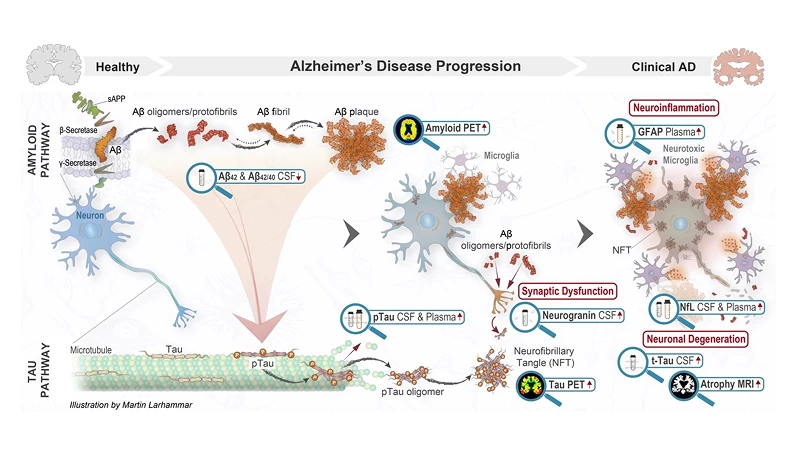
A new real‑world study from the Memory Clinic at Karolinska University Hospital in Solna helps clarify which patients may be suitable for treatment with anti‑amyloid therapies such as LEQEMBI (lecanemab).1 The study included a relatively young patient group compared with the average age at Swedish memory clinics and provides useful insights into how patient selection may look like in everyday clinical practice. The results may support the ongoing discussion about how patients are identified and selected as disease‑modifying treatments are introduced in Swedish specialist care.
Anna Rosenberg and Anna Matton from the Memory Clinic at Karolinska University Hospital in Solna, involved in the real‑world study exploring which patients may be suitable for treatment with anti‑amyloid therapies such as LEQEMBI (Rosenberg et al. 2026)
Before starting an anti‑amyloid therapy (AAT), a careful assessment is needed to check whether the patient is suitable and meets the criteria set by the European Medicines Agency. A new study from the Memory Clinic at Karolinska University Hospital in Solna—where many patients are young (under 65)—shows what proportion of these patients could be eligible for the recent EU‑approved anti‑amyloid therapies lecanemab (Leqembi) and donanemab (Kisunla), based on criterias from the European Medicines Agency and published Appropriate Use Recommendations (AUR).1 The study includes 410 consecutive patients who underwent a full biomarker‑based dementia work‑up with CSF analysis, MRI, and APOE genotyping.
The results show that only a small proportion of patients met the criteria in the international Appropriate Use Recommendations (AUR). In total, 6% of patients were eligible for treatment under the AUR for lecanemab and 6% for donanemab. One limitation is that the patients were much younger than at a typical memory clinic. Because of this, the share of eligible patients may be higher at memory clinics across Sweden, for example, more patients are expected to be amyloid‑positive at memory clinics with more elderly patients. On the other hand, in such populations, comorbidities might also reduce eligibility. International data suggest that up to 15% of patients at memory clinics could be eligible for AAT, which would correspond to about 1,000–1,500 patients in Sweden.2
The study highlights that the main limiting factors were not age or cognitive status, but lack of amyloid pathology (83% of the full cohort were Aβ‑negative) and APOE‑related exclusions. After exclusion of ApoE4 homozygotes in accordance with the European label, 3% remained eligible. The authors link this to the high proportion of younger patients, and to the fact that the Solna memory clinic evaluates many different types of cognitive problems.
Overall, the study suggests that relatively few patients may be eligible for anti‑amyloid treatment initially after disease‑modifying treatments (DMTs) are introduced in Swedish specialist care. Based on the findings in this study we believe that there is a need for implementation of blood‑based biomarker tests already in primary care, so that more patients with amyloid positivity can be selected for future DMT treatment. Another study has recently been completed at seven other memory clinics in Stockholm with a higher proportion of elderly patients, and will demonstrate how their patient populations compare with a highly specialized university clinic such as the one in Solna.